
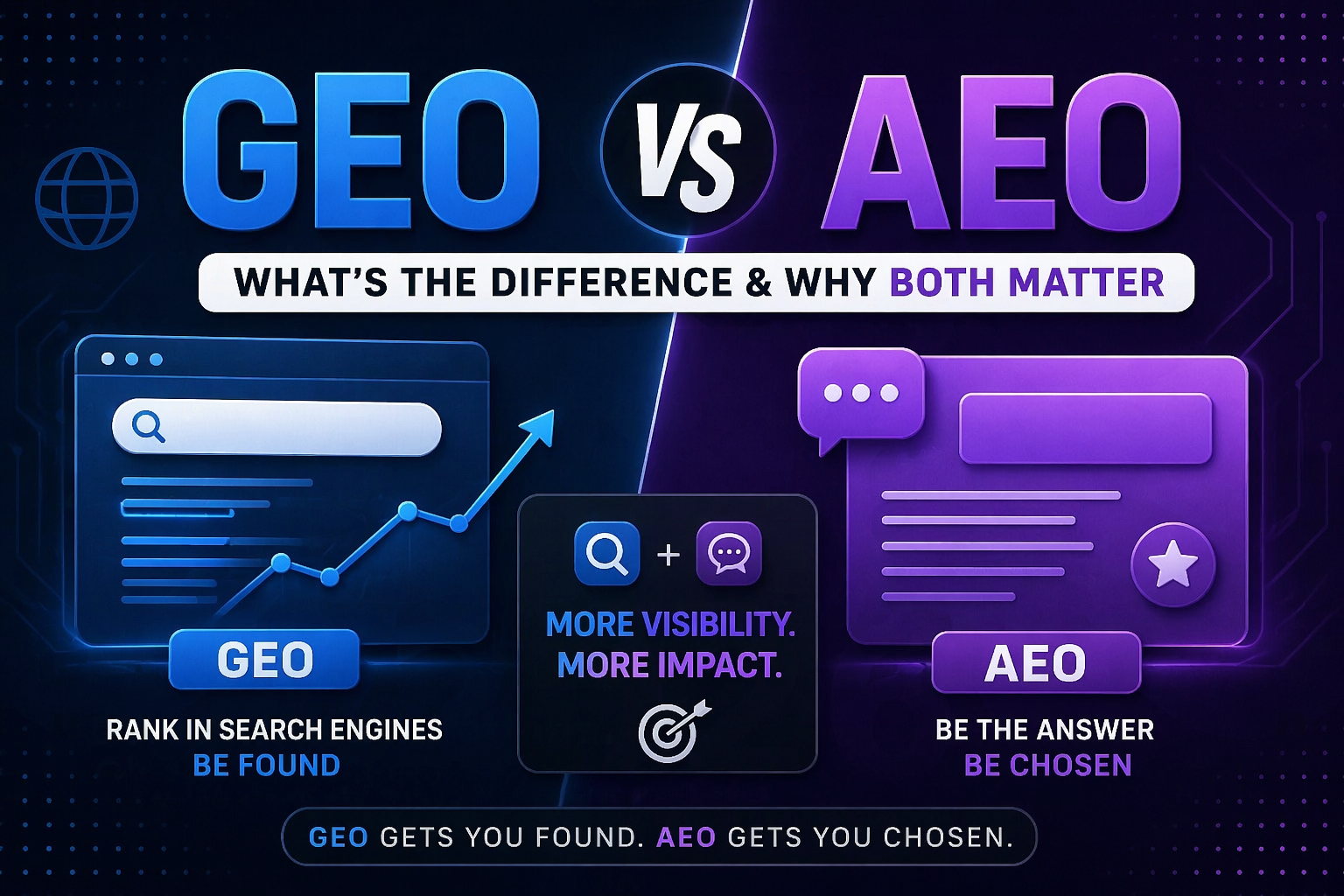
GEO vs AEO: What’s the Difference & Why Both Matter
Published on
The New Reality of AI-Powered Search
Not long ago, the game was simple: rank on Google, get clicks, done. But 2024 changed everything — and 2026 is making it even more complex.
Think about the last time you searched for something. Did you type a keyword into Google and scroll through 10 blue links? Or did you ask ChatGPT? Use Google’s AI Overview? Talk to Siri or Alexa? Maybe you asked Perplexity to give you a direct answer?
That’s the new search landscape — and most businesses are still operating like it’s 2018. They’re optimizing for one engine, one type of user behavior, and one kind of visibility. That’s a losing strategy in 2026.
Today, being found online requires a three-layered approach: Traditional SEO, Answer Engine Optimization (AEO), and Generative Engine Optimization (GEO). Let’s break down exactly what each one means — and why neglecting any of them is costing you traffic, leads, and revenue.
What is SEO? (Still the Foundation)
Let’s not reinvent the wheel. Search Engine Optimization (SEO) is the practice of optimizing your website and content so it ranks higher on traditional search engines like Google and Bing. You’re still optimizing for humans clicking on links from a results page.
SEO works through three main pillars:
- On-page SEO — Keyword research, title tags, headers, meta descriptions, content quality, internal linking
- Technical SEO — Site speed, Core Web Vitals, mobile-friendliness, crawlability, schema markup
- Off-page SEO — Backlinks, brand authority, social signals, E-E-A-T (Experience, Expertise, Authoritativeness, Trustworthiness)
Key point: SEO is not dead. Google still processes over 8.5 billion searches per day. If you abandon SEO chasing the next shiny thing, you’ll lose your biggest traffic source. Build on the foundation — don’t burn it.
However, SEO alone is no longer enough. Google’s AI Overviews now answer many queries without sending a single click to your site. That’s where AEO and GEO come in.
What is AEO? Answer Engine Optimization Explained
“People don’t want 10 links anymore. They want one right answer.” — That’s the premise behind Answer Engine Optimization.
AEO is the practice of optimizing your content to be selected as a direct answer by search engines, voice assistants, and featured snippets. The “answer engines” here include:
- Google’s Featured Snippets and People Also Ask boxes
- Google’s AI Overviews (SGE)
- Voice assistants: Siri, Alexa, Google Assistant
- Bing’s AI-integrated search results
How to Optimize for AEO
AEO is built on one simple idea: structure your content to directly answer the questions your audience is asking. Here’s how:
What is GEO? Generative Engine Optimization Explained
GEO is newer, bigger, and arguably the most important frontier in digital marketing right now. Generative Engine Optimization (GEO) is the practice of optimizing your content to be referenced, cited, or synthesized by AI language models like ChatGPT, Claude, Gemini, and Perplexity.
Unlike SEO (which drives traffic to your site) or AEO (which earns you a direct answer slot), GEO ensures that when AI models generate responses, your brand, data, or expertise is part of what they say.
The fundamental difference: GEO is about becoming a source that AI trains on, cites, or recommends — not just ranking on a results page.
Why GEO Is Different from Everything Else
When someone asks ChatGPT, “What’s the best project management tool for remote teams?”, the AI doesn’t show 10 links. It synthesizes information from across its training data and the web — and gives a confident, conversational answer. If your brand is mentioned in high-authority sources, reviews, forums, and structured content, you’re more likely to appear in that answer.
GEO Optimization Checklist
Think of it this way: GEO is like SEO for the AI internet. Instead of ranking on a page, you’re trying to be the source AI trusts, cites, and recommends when users ask questions in natural language.
GEO vs AEO vs SEO: The Key Differences
| Aspect | SEO | AEO | GEO |
|---|---|---|---|
| Target | Google/Bing results pages | Featured snippets, voice, PAA | ChatGPT, Gemini, Perplexity, Claude |
| Goal | Rank in top 10 links | Be the direct answer | Be cited in AI responses |
| Format | Click-through traffic | Zero-click, voice response | Brand mentions in AI output |
| Metric | Organic rankings, CTR | Snippet wins, voice visibility | AI brand mentions, citations |
| User Type | Active searchers browsing links | People wanting instant answers | AI-first searchers, conversational queries |
Why Your Business Needs All Three — Not Just One
Here’s a common mistake: businesses discover GEO or AEO and think they can replace SEO. Or they double down on traditional SEO and ignore AI entirely. Both approaches are wrong.
Think of it like a three-legged stool. Remove one leg, and the whole thing falls over.
- SEO without AEO — You rank on page 1, but Google’s AI Overview answers the question above your result. You get no click. You need AEO to compete at position zero.
- SEO without GEO — Your site gets Google traffic, but when someone asks ChatGPT for a recommendation in your category, a competitor’s brand is mentioned. You’re invisible in the fastest-growing search channel.
- GEO without SEO — AI might mention you, but your site can’t convert the traffic because it’s not technically sound or content-rich enough. You need SEO as the foundation.
- AEO without GEO — You win voice search snippets but miss the users who’ve switched entirely to ChatGPT or Perplexity for research. The user base is shifting faster than most realize.
The winners in 2025 and beyond will be brands that build holistic visibility — showing up in traditional search, in featured snippets and voice, and in AI-generated answers. It’s not about choosing one. It’s about mastering all three.
A Practical Action Plan: Your 2025 SEO + AEO + GEO Strategy
Now let’s get tactical. Here’s a step-by-step framework any business can implement — whether you’re a solo founder, a marketing team, or a growing brand.
Phase 1 — Fix Your SEO Foundation (Weeks 1–4)
- Conduct a full technical SEO audit (use tools like Ahrefs, Semrush, or Screaming Frog)
- Fix Core Web Vitals issues — page speed, LCP, CLS, INP
- Build a comprehensive keyword map targeting informational, commercial, and navigational intent
- Ensure your content demonstrates E-E-A-T — cite sources, show expertise, build trust signals
Phase 2 — Build AEO Content (Weeks 4–8)
- Identify your top 20 questions customers ask — use AnswerThePublic, Google PAA, and sales team input
- Write dedicated Q&A pages with concise 40–60 word answer paragraphs at the top of each section
- Implement FAQ schema and Article schema across key pages
- Restructure blog posts with question-format H2/H3 headings
Phase 3 — Execute Your GEO Strategy (Ongoing)
- Publish original research: annual surveys, proprietary data, benchmark reports
- Pursue high-authority backlinks: industry press, Wikipedia mentions where relevant, peer-reviewed or industry association citations
- Maintain active, consistent presence on Reddit, Quora, and niche forums — AI models read these
- Monitor your brand mentions in AI tools (use ChatGPT/Perplexity to ask about your category and see if you appear)
- Build relationships with journalists and podcasters — media mentions increase AI model familiarity with your brand
Pro Tip: Test your GEO visibility today. Open ChatGPT or Perplexity and ask: “What are the best [your product category] companies?” If your brand doesn’t appear, your GEO strategy starts now. Document the current state — it becomes your baseline metric.
Stop Choosing. Start Doing All Three.
The search landscape in 2025 is not a single battlefield anymore. It’s three interconnected arenas — and the brands winning are the ones showing up in all of them.
Traditional SEO keeps your organic traffic flowing. AEO puts your brand in the “position zero” answer boxes that voice assistants and AI Overviews pull from. GEO ensures that when someone fires up ChatGPT, Gemini, or Perplexity and asks a question in your space, your brand, your data, and your expertise are part of the answer.
This isn’t about trend-chasing. It’s about understanding that your customer’s search behavior has fragmented — and your visibility strategy needs to match that fragmentation.
Start with SEO. Layer in AEO. Build toward GEO. The businesses that treat this as a holistic system — not three separate projects — are the ones that will dominate search visibility in the AI era.
Ready to Build Your AI-Era Search Strategy?
Start by auditing where you currently stand across SEO, AEO, and GEO — then build a roadmap that covers all three.
Written by
Shreya
-Hii, I am SEO specialist skilled in optimizing websites, enhancing online visibility, and driving organic growth through strategic keyword research and content optimization.